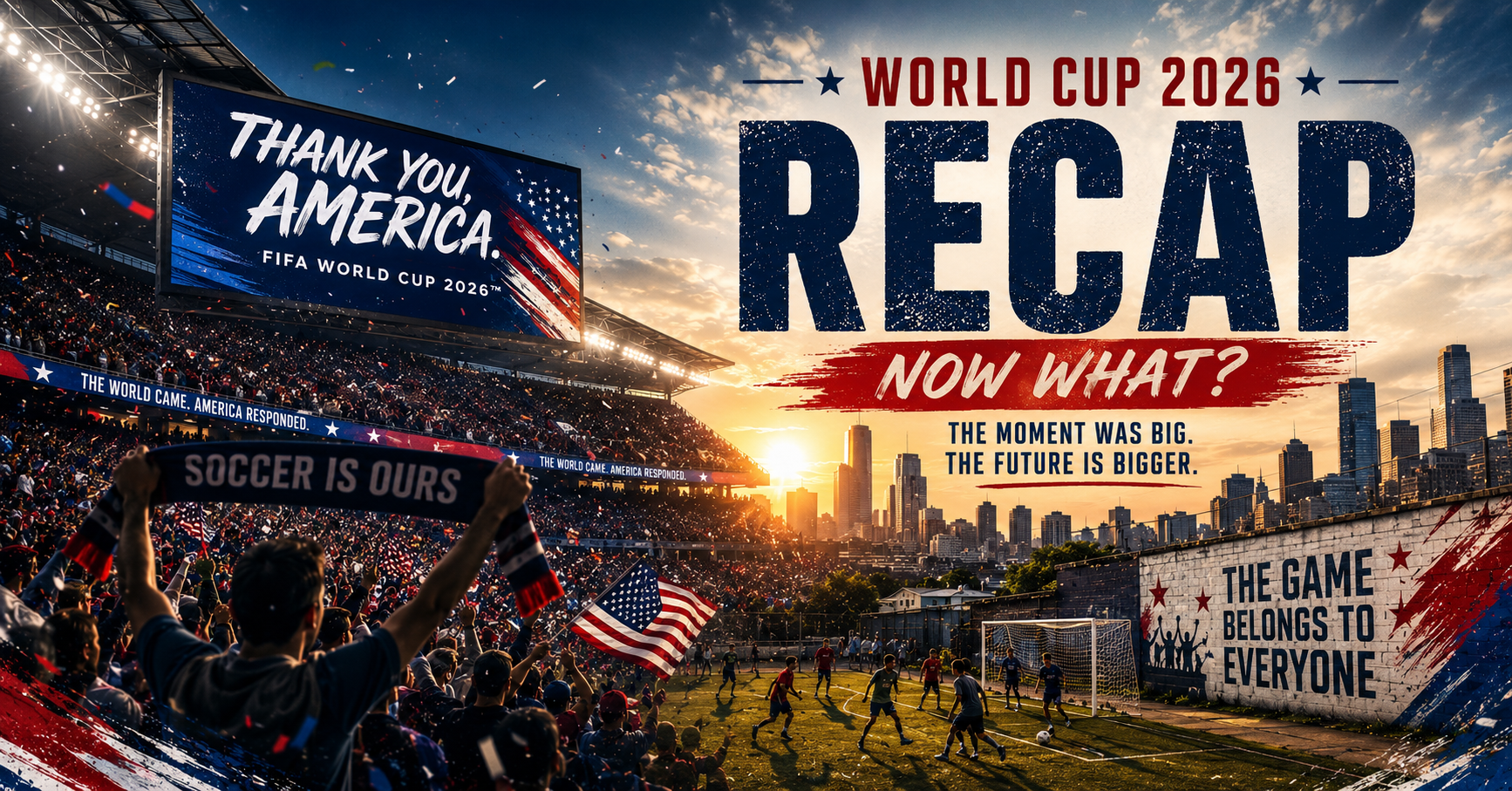
For six weeks this summer, something different happened in America.
Bars were packed for 3 PM kickoffs on weekdays. Office workers were refreshing score apps during meetings. A generation of kids who grew up playing travel soccer watched the United States beat Bosnia and Herzegovina with 10 men and felt something they may not have felt before: that this sport, their sport, belonged on the biggest stage in the world.
Then nearly 63 million U.S. viewers watched the World Cup final.
That is not a normal soccer number in the United States. That is NFL playoff territory. And while Spain and Argentina were the ones playing, America was the one watching, hosting, filling stadiums, and generating the kind of cultural noise that the sport has spent decades trying to manufacture here without success.
So the question everyone in soccer is asking right now is the only one that matters: does any of this stick?
The Numbers Were Real
Let's start with what actually happened, because the scale of it deserves acknowledgment.
The USMNT's Round of 16 match against Belgium drew roughly 46 million viewers across broadcasts, a massive number even in a 4-1 loss. The Bosnia win, played with a man down for the final half hour, drew 24.4 million on the English-language broadcast. The final, a match with no U.S. involvement, still pulled 62.8 million viewers across Fox, Telemundo, and Peacock.
Nearly 7 million fans attended matches in person across the United States, Canada, and Mexico. The atmosphere at MetLife, at SoFi, at AT&T Stadium was not manufactured. It was real.
These are not numbers you explain away as casual curiosity. Something shifted.
MLS Is Already Feeling It
Major League Soccer did not wait for the confetti to settle. Their post-tournament marketing campaign, "Thanks World, We'll Take It From Here," launched before the final whistle blew, and the numbers they are working with are already encouraging.
Reported MLS viewership was up 62% in 2026 before the World Cup even started, driven partly by making games more accessible after moving beyond the standalone Apple TV Season Pass paywall. Average attendance is sitting at 22,109 per match, second-highest in league history. The Colorado Rapids drew 75,824 fans to Empower Field at Mile High in April. LAFC packed 75,673 into the LA Memorial Coliseum in February.
These are real crowds. Not inflated by a one-time event, but by a league that has quietly been building something for years and is now positioned to capture the World Cup wave.
The challenge is sustaining it. The history of soccer in America is a history of moments that did not convert. The 1994 World Cup was supposed to change everything. Beckham to LA Galaxy was supposed to change everything. The women's national team winning in 1999 was supposed to change everything. Each time, the sport grew a little, and then the moment faded.
This time feels different in scale. But feeling different and being different are not the same thing.
There is also a reality check here. World Cup attention does not automatically become weekly MLS viewing, and not every host-city economic promise landed perfectly. Packed stadiums and record TV audiences give American soccer a larger funnel. They do not guarantee that casual fans will keep showing up when the tournament is gone.
The Pay-to-Play Problem Is the Real Barrier
Here is the uncomfortable truth about American soccer that no amount of World Cup viewership numbers changes: if you cannot afford it, you cannot play it.
Travel soccer in the United States costs families anywhere from $3,000 to $20,000 per year when you factor in club fees, equipment, travel, and tournament entry. The system filters out enormous talent before it ever gets a chance to develop, and it produces a national team that skews toward kids whose parents could afford the investment, not necessarily the best players the country has to offer.
The governing body knows this. US Soccer COO Dan Helfrich has been direct about it: the goal is not to make the current system more affordable. The goal is to build a different system entirely.
That ambition is showing up in concrete programs. The Soccer at Schools initiative, a partnership between US Soccer, the Soccer Forward Foundation, and Bank of America, aims to put soccer in every school in the country by 2030. The US Soccer Foundation has installed more than 900 mini-pitches in underserved communities, with a target of 1,000 by the end of this year. MLS has established a grant program that pays grassroots clubs for developing players who reach the top level.
These are meaningful steps. They are also long-term investments with long-term payoffs. A kid who picks up a ball on a mini-pitch in 2026 is not on the USMNT until 2040 at the earliest. The structural change is happening, but slowly, and it will take a generation to see the results.
Will American Kids Dream of Soccer?
This is the cultural question underneath all the others, and it is the hardest one to answer.
The argument against is familiar: football, basketball, and baseball have century-long head starts in American culture. The NFL is not going anywhere. The NBA is the sport of the next generation. Youth football numbers are declining, but they are declining toward other American sports, not necessarily toward soccer.
The argument for is what you saw this summer. Kids who already play soccer, and there are millions of them across one of the country's biggest youth sports, watched the World Cup and saw themselves in it. The USMNT reaching the Round of 16, even losing the way they lost, gave American soccer players a reference point that did not exist before. These were players who looked like them, who came from clubs they recognized, playing on the biggest stage in the world.
Messi and Ronaldo dominated a generation of American soccer dreams because there was no American equivalent. Pulisic has been the closest thing, and he is legitimately world-class. But the next generation of American players needs more than one Pulisic. They need a pipeline, and the pipeline only works if the kids at the bottom of it can afford to get in.
That is why the pay-to-play reform matters more than any World Cup viewership record. The nearly 63 million people who watched the final will move on. The kid in an underserved neighborhood who gets access to a mini-pitch and a school program and a pathway that does not cost their family $10,000 a year could be the one who changes what American soccer looks like in 2040.
Parting Words
The 2026 World Cup was not the beginning of soccer in America. The sport has been growing here for decades, quietly and steadily, in ways that do not always show up in prime-time ratings or cultural conversation.
But it may have been the moment when American sports fans who were not already soccer converts looked up and paid attention. Nearly 63 million U.S. viewers watched the final. Millions more filled stadiums and watched in bars and checked scores on their phones during games they would not have cared about five years ago.
Whether that translates into sustained MLS growth, deeper youth participation, and eventually a USMNT that can win on the biggest stage depends on decisions being made right now. On whether the mini-pitches get built. On whether the school programs get funded. On whether the kids who cannot afford travel soccer get a pathway anyway.
The World Cup gave American soccer its biggest moment. The question is what they build with it.
Follow Crystal Ball Picks for soccer coverage, picks, and more as MLS heads into the second half of the season.