The Miami Dolphins spent the better part of six years trying to make the Tua Tagovailoa era work. They built one of the most exciting offensive rosters in the NFL around him, hired coordinators to maximize him, surrounded him with Tyreek Hill and Jaylen Waddle, and put him in position to be a franchise quarterback.
It did not work. Not enough.
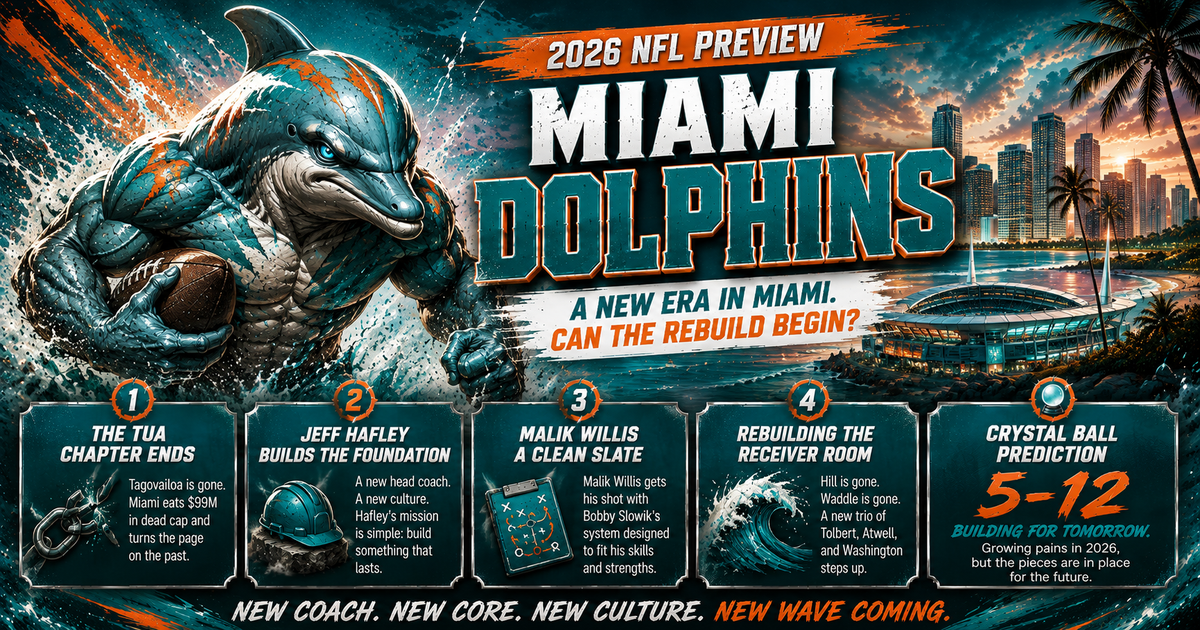
This offseason, the Dolphins made a decision that franchises rarely have the stomach to make this cleanly: they accepted the loss, absorbed roughly $99 million in dead cap, released Tagovailoa, traded Waddle to Denver, and let Hill go. They hired a new general manager, a new head coach, and a new quarterback. They used 13 draft picks to begin restocking a roster that had been depleted chasing a window that never fully opened.
This is not a contending team. It is a building team. The question for 2026 is whether what is being built is something real.
The Tua Reckoning
Cutting Tua Tagovailoa with roughly $99 million in dead money is the kind of move that defines the beginning of an era and the end of one simultaneously.
The Dolphins absorbed it. The decision to release Tagovailoa, who ultimately signed with the Atlanta Falcons, ended a chapter that produced exciting moments, legitimate playoff years, and a level of offensive production Miami has rarely achieved. It also produced injury seasons, durability questions, and the constant sense that the team was never quite good enough when January arrived.
New general manager Jon-Eric Sullivan, hired from the Green Bay Packers' front office, read the situation clearly. The offensive weapons the Dolphins had built around Tagovailoa, Hill, Waddle, the pass-catcher infrastructure, were not going to survive a rebuild intact. If you are starting over at quarterback, you are starting over. Sullivan stripped the roster, loaded up on draft capital, and handed the rebuild to a head coach he trusted.
That coach is Jeff Hafley.
Jeff Hafley's Foundation Year
Hafley arrived from the Green Bay Packers' defensive coordinator role as one of the more respected defensive minds in the league. His pedigree includes stints at Ohio State, Boston College as head coach, and a Packers staff that produced winning football under challenging conditions.
The mandate in Miami is not to win in 2026. It is to install a culture, build a foundation, and begin developing the personnel that will make the Dolphins competitive inside of three years. Hafley is a process coach in the best sense of the phrase: someone who knows how to build a program rather than just manage a roster.
At training camp, the early reports are consistent: the accountability level is different. The preparation standard is different. Players who have been in locker rooms that operated year-to-year without a coherent plan have noticed a shift in how this building operates. That matters more in Year One than wins in September.
The wins will come. They will not come fast. Hafley knows that, and the franchise appears to as well.
Malik Willis and a Clean Slate
The most interesting story in Miami this summer is Malik Willis.
Willis signed a three-year, $67.5 million deal with $45 million guaranteed after spending time with Hafley and Sullivan in Green Bay, backing up Jordan Love and absorbing a system that emphasized accuracy, decision-making, and controlled aggression with his legs. He filled in for Love in a tiny 2025 sample, totaling 422 passing yards, 123 rushing yards, and five total touchdowns, and showed enough to earn a starting opportunity.
The preseason debut was encouraging. Against the Washington Commanders, Willis completed 4 of 5 passes for 43 yards, averaged 8.6 yards per attempt, and led a 93-yard touchdown drive on the Dolphins' opening possession before the starters came out. One drive is one drive. But the composure was real, and the connection with his teammates looked like more than just early camp work.
Offensive coordinator Bobby Slowik has been direct about the approach: Willis is not being asked to carry the offense by himself. He is being asked to manage it, protect the ball, use his legs when the pocket breaks down, and let the structure of the system create opportunities. That is a significant adjustment from the deep-shot Tua offense that defined Miami's last few seasons, and it fits Willis's actual skill set better than any environment he has played in before.
The ceiling on this offense is not high in 2026. The floor, with a mobile quarterback who is not going to try to win every game himself, might be more stable than people expect.
A Receiver Room Built From Scratch
If there is one position group that tells the whole story of this rebuild, it is wide receiver.
Tyreek Hill is gone. Jaylen Waddle is in Denver. The two receivers who made Miami one of the most feared passing attacks in the NFL for three seasons are not on this roster. What remains is a collection of players competing for jobs, roles, and the chance to be part of whatever this offense becomes.
Jalen Tolbert, signed from Dallas, leads the depth chart into camp. Tutu Atwell, acquired from the Rams, gives the room a quick-twitch slot option who fits the underneath game Slowik wants to build. Malik Washington is the veteran anchor who caught 46 passes in 2025 while playing behind Hill and Waddle and never really got a chance to be a primary option.
The most interesting names are the rookies, and one of them has already changed the conversation.
Caleb Douglas, the Texas Tech receiver, was a draft pick that drew groans from a fan base that wanted a proven name at a position of obvious need. The pre-draft profile was not perfect, but camp has been much louder than the initial reaction. Douglas has been winning routes, making plays on the ball, and showing the kind of football instincts that do not always show up on a draft board. Whether he can sustain that production into the regular season and eventually become a true WR1 is still an open question. But he has earned the right to get a real look.
Chris Bell, the Louisville receiver who finished his college career with 151 catches, 2,166 yards, and 12 touchdowns, enters the picture with something to prove on his own timeline. Bell was a first-team All-ACC selection and Biletnikoff semifinalist in 2025 before a late-season ACL tear, and he was recently activated back onto the roster after getting healthy. The first-look connection between Bell and Douglas in camp has been one of the quiet storylines of the summer: two players who might actually be building something real at the position Miami was most worried about filling.
If Bell and Douglas develop into a legitimate WR1 and WR2 by midseason, the Dolphins' offense becomes significantly harder to game-plan against. That is not guaranteed. Bell needs healthy reps before anyone can project what he will be. Douglas needs to prove that camp production translates on Sundays against press coverage from cornerbacks who have film on him. But the upside is real, and for a team that stripped the receiver room entirely this offseason, finding two young pieces with actual chemistry this early is better than anyone had a right to expect.
Will Kacmarek, the Ohio State tight end taken in the third round, gives Miami a big-bodied Y tight end who can help the run game and occasionally work as a short-area target. He is more blocker than seam weapon right now, but that still matters for an offense trying to make life easier on Willis.
None of this is Tyreek Hill. None of this is Jaylen Waddle. It is an honest accounting of where Miami is in the receiver room hierarchy, and it will require time to develop. But Douglas and Bell are reasons to watch, and in a rebuild, finding two reasons to watch at the same position is something worth holding onto.
What Slowik is building here is a structure that does not rely on one elite receiver carrying the offense. Motion, quick game, run-pass balance. It is a system built around making the quarterback's job manageable rather than asking the quarterback to win on talent alone. For a team in Year One of a rebuild, that is the right approach.
The Offensive Line Gets a Foundational Piece
One thing the Dolphins did right this offseason: they addressed the offensive line with their top draft pick.
Kadyn Proctor, the Alabama offensive tackle taken 12th overall, has converted to left guard during training camp and the transition has been seamless. The 6-foot-6, 352-pound rookie gives Miami rare size on the interior, and center Aaron Brewer, recently extended, said Proctor "looks like a veteran" after the first few weeks of practice, which is not the thing you normally say about a first-round rookie at a new position.
Adding Jamaree Salyer and Charlie Heck at tackle gives the line depth it has not had in recent years. If Proctor develops into a long-term starter at guard and the tackle spots stabilize, Miami has the foundation of an offensive line that can keep Willis upright long enough for the offense to develop.
Protecting the quarterback is the highest priority for a rebuilding team with a mobile signal-caller who has a tendency to extend plays. Hafley, Sullivan, and Slowik addressed it directly. That is a good sign.
A Young Defense Getting Baptized
The defense is where the growing pains will be most visible in 2026, and the secondary is going to face a trial by fire from the first snap of the regular season.
Chop Robinson takes over as the primary edge rusher after Bradley Chubb left for Buffalo. Robinson had a sophomore slump in 2025 after a promising rookie year, and this is the season where he needs to show that was a setback, not a ceiling. Josh Uche, signed from New England, lines up opposite Robinson with 11.5-sack and pressure-production credentials. David Ojabo gives the room situational depth. The front has upside. It is not proven.
The secondary is an experiment in progress. Julius Brents and Jason Marshall Jr. return as young cornerbacks who showed flashes in limited roles last year. First-round pick Chris Johnson, out of San Diego State, is competing for immediate starting time, which is a lot to ask of a rookie corner. Miami loaded up on length and physicality at cornerback, and Brents brings some of the longest arms at the position. But the communication, recognition, and technique that take young defensive backs two and three years to develop cannot be fast-tracked.
Safety Lonnie Johnson provides veteran leadership in the back end. Fifth-round pick Michael Taaffe from Texas, a former walk-on who racked up seven interceptions and 222 tackles in Austin, projects as a developmental piece with a nose for the ball. Jacob Rodriguez, the Texas Tech inside linebacker, gives Hafley a second-level player who fits the athleticism requirements of the modern defense.
This unit will get beaten on Sundays this year. The question is not whether it will happen. The question is whether the young players develop fast enough to keep games winnable into the fourth quarter.
The AFC East Picture
The AFC East is the Buffalo Bills' division, and there is not much reason to pretend otherwise in 2026. The Patriots are young and still developing under Drake Maye. The Jets are working through their own reset. Miami is the most transparent of the rebuilding projects.
The Dolphins are not pretending 2026 is a playoff year. They are not selling tickets on promises. The Hafley hire and the Sullivan philosophy suggest a franchise that has accepted the timeline that a real rebuild requires and is committed to doing it right.
That is meaningful. Miami has spent years making decisions that compressed the rebuild cycle in ways that never actually worked. This feels different. Less reactionary, more structural.
What success looks like in 2026 is not a playoff berth. It is Willis developing into a reliable starting quarterback, the offensive line becoming an actual unit, the young receivers giving Hafley something to build around, and the secondary surviving its baptism with enough reps to come back better in 2027.
Crystal Ball Prediction
Win total: 5-12. Rebuilding year, AFC East basement.
The Dolphins have the right regime, the right quarterback for the moment, and the right approach. What they do not have is the roster depth to compete in a division with the Bills, or the secondary to hold up against AFC offenses that will attack them relentlessly.
Five wins is honest. It might be six if Willis catches the league off guard in a few early games. It might be four if the secondary gets exposed in back-to-back weeks and the young corners lose confidence before they find their footing.
But here is the thing about watching the Dolphins this year: for the first time in a while, you can watch this team and believe there is a plan. Hafley is a real coach. Sullivan is a real GM. Willis is a real quarterback who is being put in a real system by Slowik. That is more than Miami has been able to say with a straight face for most of the last decade.
The wins will come. Just not yet.
Make your NFL picks at Crystal Ball Picks.