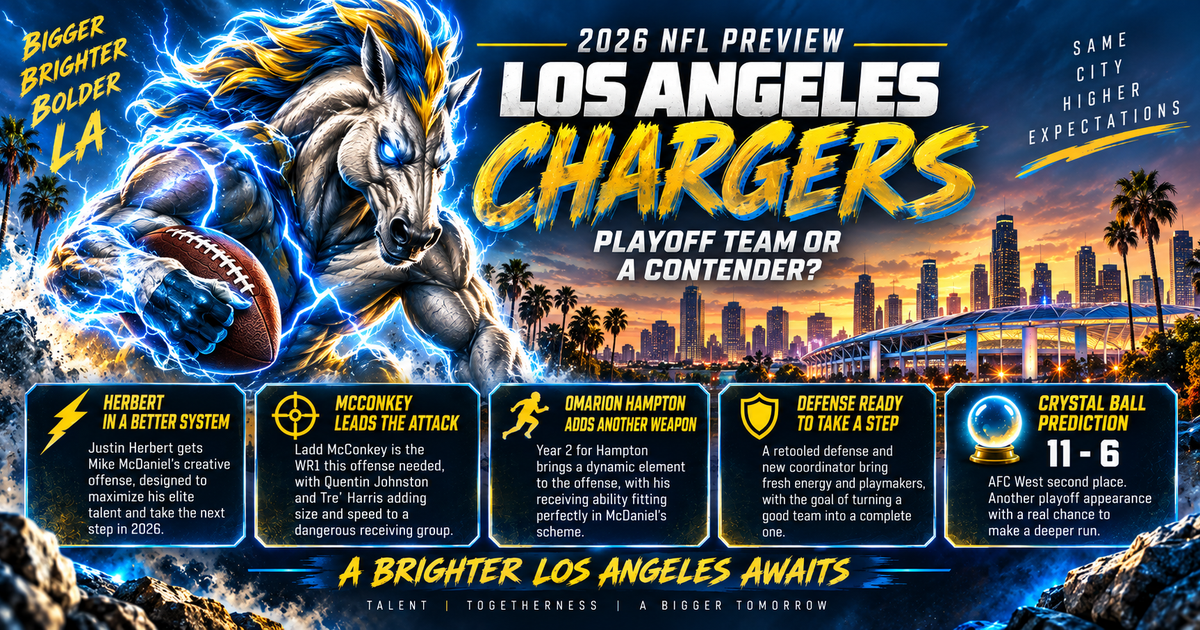
The Los Angeles Chargers have won 11 games in back-to-back seasons. They have lost in the Wild Card round in back-to-back seasons.
This is the defining tension of the current Chargers era: a team that is clearly good enough to make the playoffs and has not yet proven it is good enough to win in January. Justin Herbert is an elite quarterback. The offensive line, when healthy, is one of the best in football. The skill position group has developed into a legitimate threat. The defense has been retooled with a new coordinator and new pieces.
Everything points to a team on the verge of something. Two consecutive first-round exits say the verge is not the same as the destination.
2026 is the year Los Angeles has to answer the question it has been building toward for three seasons: is this a playoff team, or is this a contender?
Justin Herbert and the System He Needed
Justin Herbert is one of the best quarterbacks in football. His arm, his accuracy, his ability to process coverage quickly and deliver the ball on time -- those things have never been in question. What has been in question is whether the offense around him was designed to maximize what he does best.
The hire of Mike McDaniel as offensive coordinator is the most significant move the Chargers made this offseason, and it is a direct response to that question.
McDaniel spent three seasons in Miami building one of the most creative offensive systems in the league around Tua Tagovailoa -- a system built on spacing, motion, pre-snap manipulation, and getting skill players the ball in space where they can create. The scheme produced the most explosive passing attack in the NFL in 2023 and demonstrated that McDaniel's approach can make quarterbacks better by reducing what they have to improvise and increasing what they can execute from structure.
Herbert is a better quarterback than Tagovailoa. He has more arm talent, more pocket mobility, and more ability to extend plays when the structure breaks down. What McDaniel's system gives him is a scheme that does the heavy lifting before the snap -- identifying favorable matchups, creating favorable alignments, and putting the quarterback in positions to execute rather than solve problems on the fly.
Early camp reports have been excellent. Herbert has credited the new system with improving his pre-snap processing and his comfort in rhythm throws. The marriage of an elite quarterback and a creative coordinator is the kind of combination that changes a franchise's January ceiling, and the Chargers are betting that this combination does exactly that.
Ladd McConkey Is the WR1 This Offense Needed
The most important skill-position development in Los Angeles over the past two seasons has been the emergence of Ladd McConkey as a legitimate WR1.
McConkey is not a typical WR1 in the size-and-speed mold. He is a route runner -- precise, creative, and endlessly reliable in the intermediate game that McDaniel's system is built around. He creates separation against zone coverage by identifying soft spots and sitting down in them. He creates separation against man coverage by running routes so cleanly that defenders cannot stay attached. He catches everything Herbert throws at him.
In McDaniel's system, McConkey is the ideal slot and movement piece -- a receiver who can be aligned anywhere, run any route in the tree, and give Herbert a reliable answer on every down and distance. The early camp connection between Herbert and McConkey in the new offense has been one of the more discussed storylines out of Los Angeles, with reports suggesting that the two have already developed the kind of trust that takes most quarterback-receiver combinations years to build.
Quentin Johnston provides the vertical threat opposite McConkey -- the size and speed to stress a defense deep and create the space underneath that makes McConkey's game work. Tre' Harris gives the Chargers another outside option with proven production, and Omarion Hampton gives McDaniel a lead backfield piece with receiving ability that fits the scheme perfectly.
Hampton, now in Year 2, is one of the most intriguing pieces in the offense. McDaniel's Miami offenses used running backs extensively in the passing game -- screen passes, swing routes, wheel routes that stretched linebackers into coverage -- and Hampton's receiving ability gives him a chance to be that kind of weapon at the NFL level. Keaton Mitchell and Kimani Vidal give the backfield different change-of-pace options, but Hampton is the player who can make the entire structure harder to defend if he takes the expected leap.
The Offensive Line Is the Biggest Swing Factor
The Chargers' offensive line is the most important health story on either side of the ball.
Rashawn Slater at left tackle and Joe Alt at right tackle give Los Angeles one of the best bookend pairings in football -- when both are healthy. Slater has missed significant time in recent seasons with injuries that disrupted the line's continuity and put Herbert under pressure at crucial moments. Alt has already become one of the league's better young right tackles but also dealt with his own durability concerns.
When Slater and Alt are healthy and on the field together, the Chargers' offensive line is capable of protecting Herbert long enough for McDaniel's system to operate at its highest level. The bigger concern is the interior after Tyler Biadasz suffered a season-ending ACL injury in camp, forcing rookie Jake Slaughter into the starting center role alongside Kayode Awosika and Cole Strange. The tackles give this line a high ceiling, but the middle has to prove it can hold up before the whole unit can be called one of the league's best.
The risk is the injury history. A line that cannot stay healthy cannot be evaluated at its ceiling, and the Chargers have spent parts of the last two seasons finding out what the offense looks like when the tackles are not both on the field. The answer is: worse. Getting Slater and Alt through a full 17-game season healthy is arguably the single biggest factor in whether Los Angeles can go further than it has gone in January.
Chris O'Leary and the Defensive Retool
The other side of the ball has been rebuilt around a new coordinator.
Chris O'Leary takes over as defensive coordinator after the Chargers' previous defensive staff was not retained following back-to-back Wild Card exits. O'Leary brings a scheme that emphasizes disguise, rotation, and pressure from multiple looks -- the kind of multiple-front approach that makes offensive line preparation more difficult and creates uncertainty for quarterbacks who rely on pre-snap identification.
The personnel around O'Leary's 3-4 structure is capable. Derwin James remains the tone-setter in the secondary, Khalil Mack and Tuli Tuipulotu give the pass rush veteran production and ascending power, and Daiyan Henley and Denzel Perryman fit the physical demands of the linebacker room. Up front, Dalvin Tomlinson gives the interior more mass and steadiness than it had a year ago. Whether the new system installs quickly and translates to early-season performance is the question -- new coordinator schemes often take half a season to hit their stride.
The defense does not need to be elite for the Chargers to compete in 2026. It needs to be good enough to keep games manageable while the offense operates at the level McDaniel's arrival suggests it can. That is a realistic ask for a unit with this personnel, but the transition from Jesse Minter to O'Leary still has to show up cleanly once the games count.
The AFC West Picture
The Chargers finished second in the AFC West at 11-6 last season. Denver went 14-3 and reached the AFC Championship Game. Kansas City missed the playoffs for the first time since 2014 but returns Mahomes from an ACL. Las Vegas is rebuilding.
Los Angeles's path to the division title runs through Denver, and beating the Broncos requires more than being good -- it requires being good enough to beat a team that won 14 games and has Bo Nix returning healthy in Year 2 under Sean Payton.
The Wild Card is the realistic floor. The division title is the ceiling. Getting from the Wild Card to a deeper playoff run is what 2026 is actually about.
Two consecutive Wild Card losses raise a legitimate question about whether the Chargers are built to win in January or built to win in November. The McDaniel hire, Hampton's Year 2 leap, the health of Slater and Alt, and Slaughter's ability to settle the middle of the line are all answers to that question. Whether they are the right answers gets determined in the games that matter.
Crystal Ball Prediction
Win total: 11-6. AFC West contender. Wild Card or better.
Eleven wins for the third consecutive season is the honest projection for a roster this talented with this many pieces in place. Herbert is elite. McConkey is a legitimate WR1. The tackles give the offensive line a high ceiling if the new interior holds up. McDaniel's system is designed to maximize everything Herbert does well.
The ceiling on this team -- if Slater and Alt stay healthy, if Hampton develops into the receiving back McDaniel wants, if Slaughter stabilizes center, and if the new defensive scheme installs quickly -- is a team capable of beating anyone in the AFC. The floor is another 11-win Wild Card exit that raises more questions about whether Los Angeles can win in January.
The Chargers are one of the most talented teams in the conference. 2026 is the year the talent has to produce a result that matches the expectation. Herbert is ready. The system is ready. The question is whether January finally is, too.
Make your NFL picks at Crystal Ball Picks.