The Las Vegas Raiders won three games last season. Pete Carroll was fired. The roster was stripped down. The front office acknowledged what the record had been suggesting for years: this franchise needed to start over.
Starting over in the AFC West -- where Denver just went 14-3, Kansas City is returning Mahomes from an ACL, and Los Angeles has won 11 games two straight years -- is not a gentle process. The gap between the Raiders and the top of their division is real, and no amount of optimistic framing changes the fact that Las Vegas is not built to chase a division title yet.
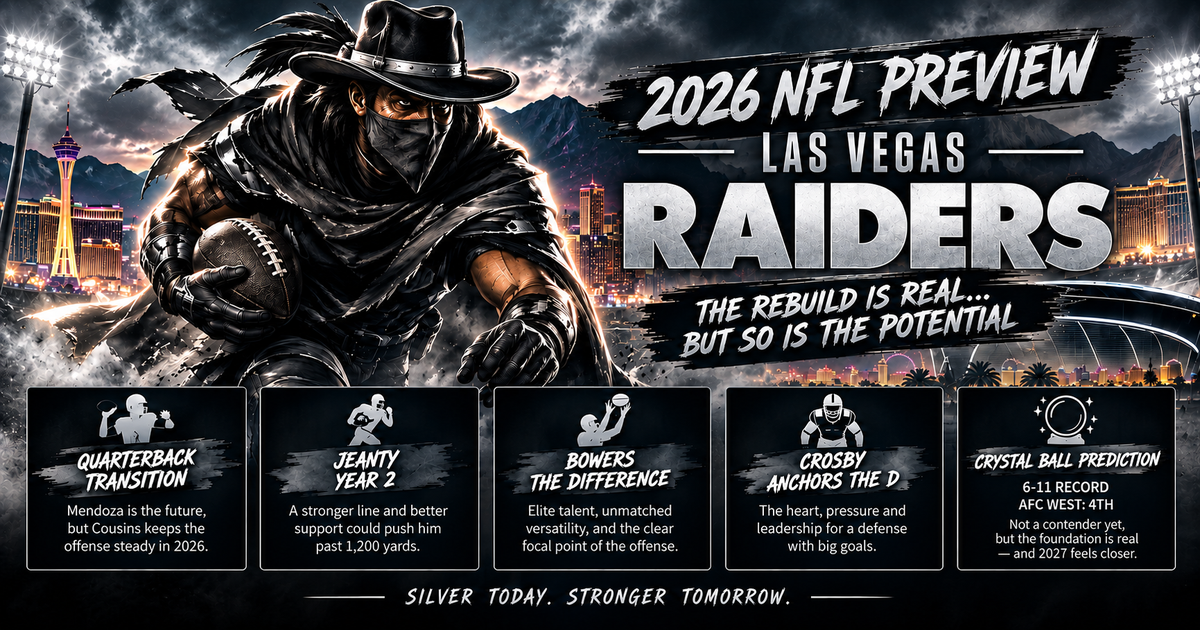
But starting over with intention is different from starting over in chaos. The Raiders have Fernando Mendoza, the No. 1 overall pick and the most celebrated prospect to enter the league in years. They have Ashton Jeanty, one of the most exciting young running backs in the AFC in just his second season. They have Brock Bowers, the best tight end in football. They have Maxx Crosby, who nearly went to Baltimore but is back as the defensive anchor. They have Tom Brady as a minority owner and John Spytek as general manager setting the organizational direction.
The foundation is more interesting than three wins suggests. Whether Klint Kubiak can build something real on top of it is the question 2026 has to begin answering.
Fernando Mendoza and the Franchise Reset
The Raiders held the No. 1 overall pick and used it on Fernando Mendoza, the Heisman Trophy winner and the most hyped quarterback prospect since Caleb Williams.
Mendoza arrives in Las Vegas after a college career defined by accuracy, poise, and the kind of football IQ that scouts and coaches associate with quarterbacks who can succeed at the NFL level without elite athleticism. His 2025 season at Indiana -- 72.0 percent completions, 3,535 yards, 41 touchdowns, six interceptions, and an undefeated national title run -- made him the cleanest quarterback evaluation in the class. He was not a runner in college -- his game was built around processing speed, touch on intermediate throws, and the ability to manipulate defenders with his eyes and shoulders before delivering the ball with anticipation. Those traits translate. The explosion that comes from scrambling and creating plays does not.
What Mendoza needs is time. Every highly drafted quarterback needs time -- time to understand the speed of the game, time to recognize NFL coverage patterns, time to develop the footwork and pocket mechanics that make the good college decisions translate to the professional field. The Raiders are giving him Kirk Cousins as a bridge, which means Mendoza is not expected to start Week 1.
Cousins gives the offense a veteran who has been a functional starting quarterback at multiple stops. He is not the answer long-term, and no one in Las Vegas is pretending he is. His role is to keep the offense from being a disaster while Mendoza learns, and to be available when Mendoza needs to watch a veteran manage a game from the sideline before taking his own turn.
The timeline on Mendoza's debut depends on how quickly he absorbs the system and how cleanly Cousins navigates the first stretch of the season. Maybe it is four games. Maybe it is half a season. Kubiak will be evaluated on whether he handles the transition correctly -- getting Mendoza on the field when he is ready, not before.
Ashton Jeanty in Year 2
The most immediately impactful player on the Raiders' offense is not the quarterback -- it is the running back.
Ashton Jeanty rushed for 975 yards as a rookie in 2025 despite playing behind a struggling offensive line and a quarterback situation that was never stable enough to force defenses out of stacked boxes. He averaged 3.7 yards per carry, but his receiving work -- 55 catches, 346 yards, and five touchdowns -- showed how much more he can be than a traditional early-down back. He showed the burst, the vision, and the contact balance that made him one of the highest-rated running back prospects in years coming out of Boise State.
Year 2 gives Jeanty a better situation in almost every dimension. The offensive line was upgraded with the signing of Tyler Linderbaum, who became the highest-paid center in the NFL this offseason. Linderbaum is one of the best interior linemen in football -- a communicator, a technician, and a run-game anchor who elevates the players around him. Getting him in Las Vegas is the kind of foundational piece that makes the running game more than a volume-stats operation.
Jeanty with Linderbaum leading the interior, Kubiak's run-game emphasis, and a quarterback situation that at minimum features a veteran who can hand off cleanly -- that is a running back who can reach 1,200 yards and remind the rest of the AFC that the Raiders have a genuine offensive weapon regardless of who is taking the snaps.
Brock Bowers Is the Best Tight End in Football
The Raiders drafted Brock Bowers to be the centerpiece of their passing game, and in two seasons he has already made that investment look prescient.
Bowers is the best tight end in football. That is not an overstatement -- it is what the tape shows. His production supports the argument: 112 catches for 1,194 yards and five touchdowns as a rookie, then 64 catches for 680 yards and seven touchdowns in 12 games last season. His combination of size, speed, route running, and yards-after-catch ability has no direct comparison at the position. He creates mismatches against linebackers who cannot match his athleticism and safeties who cannot match his size. He can line up in-line, in the slot, or split wide and win from every alignment. In a passing game that has lacked consistent playmakers around him, Bowers has been the one player opposing defenses have had to account for every single snap.
In 2026, with Mendoza eventually under center and Kubiak designing an offense around his traits, Bowers becomes even more valuable. Young quarterbacks trust tight ends -- the middle of the field is safer, the windows are bigger, and a tight end of Bowers' caliber is a safety valve and a big-play weapon simultaneously. Whoever is throwing in Las Vegas this season, Bowers will be their most reliable target.
The Receiver Room Still Has to Grow
The Raiders have the tight end centerpiece in Bowers, but the wide receiver room is still more projection than certainty. Tre Tucker gives the offense speed, Jalen Nailor adds another vertical option, and rookies Jack Bech, Dont'e Thornton Jr., and Malik Benson give Las Vegas young bodies to evaluate while the quarterback plan develops.
That group does not need to become elite overnight. It does need to give Cousins enough separation to keep the offense functional and give Mendoza enough structure when his time comes. If one of the young receivers becomes a reliable outside answer, the rebuild starts to look much cleaner.
Maxx Crosby Stays in Las Vegas
The most important defensive development of the Raiders' offseason was what did not happen.
Maxx Crosby was involved in trade discussions with the Baltimore Ravens. The deal fell through. Crosby is still in Las Vegas.
That matters. Crosby is one of the best defensive players in football -- a relentless edge rusher who generates pressure on a consistent basis, plays with exceptional effort, and sets a tone for an entire defense by the way he approaches every snap. Trading him would have accelerated the rebuild's timeline at the cost of the one player who gives the defense an identity.
Keeping Crosby signals something about the direction Kubiak and Spytek want to take the rebuild. They are not stripping the roster entirely. They are building around a defensive anchor and trying to develop the offense around Jeanty, Bowers, and eventually Mendoza. That approach is slower than a full teardown, but it keeps the team more competitive in the short term and gives Mendoza a defense worth playing in front of.
The players around Crosby are developing, and new defensive coordinator Rob Leonard has more than one piece to work with. Kwity Paye gives Las Vegas another edge option, Quay Walker and Nakobe Dean reshape the linebacker room, and Jeremy Chinn, Eric Stokes, Taron Johnson, and rookie Darien Porter give the secondary a different look. Whether the defense can stay out of the way and keep games manageable while the offense is in transition is the challenge -- and Crosby's presence makes that more realistic than it would be without him.
Klint Kubiak and the Organizational Direction
Klint Kubiak arrives as head coach after coordinating the Seattle Seahawks' offense during their Super Bowl run -- the offense that operated behind the NFC's best offensive line and helped the Seahawks reach the championship game.
His background is in the run game, in play-action, and in building offenses around intelligent ball distribution rather than asking a quarterback to improvise. Andrew Janocko, who followed Kubiak from Seattle, gives the staff an offensive coordinator already familiar with the structure Kubiak wants to install. That philosophy fits what the Raiders need: an offense that protects a young quarterback by running the ball effectively, using play-action to create cheap explosive plays, and building confidence through designed structure rather than improvisation.
The combination of Kubiak, Janocko, Jeanty, Linderbaum, and Bowers gives the offense a theoretical identity even before Mendoza takes a snap. Run the ball. Use play-action. Get Bowers isolated in matchups he can win. Protect whoever is at quarterback by keeping him in rhythm situations.
Whether Kubiak can execute that vision -- and whether he can handle the full weight of head coaching responsibilities while managing a quarterback transition -- is what 2026 has to begin evaluating.
The AFC West Reality
Las Vegas projects as the fourth team in the AFC West in 2026. The gap between the Raiders and Denver is substantial. The gap between the Raiders and Los Angeles is real. Even Kansas City, returning Mahomes from an ACL and still thin at receiver, has more established pieces than a team transitioning to its franchise quarterback.
That is not a failure. It is the honest position a 3-win team occupies entering a rebuild year. The Raiders are not trying to win the division in 2026. They are trying to answer the right questions: Can Jeanty be a true number one back? Can Bowers be even better with a healthier quarterback situation? Can Mendoza absorb the system fast enough to see meaningful playing time and show what his ceiling looks like? Can Crosby keep the defense competitive enough to keep Las Vegas in games?
Those are the right questions for a team in this position, and the 2026 season is where the answers start arriving.
Crystal Ball Prediction
Win total: 6-11. AFC West fourth place. Building toward 2027.
Six wins is meaningful progress from three, and it reflects a team with genuine playmakers -- Jeanty, Bowers, Crosby -- surrounded by enough structure to compete on some Sundays even while the quarterback situation is in transition. The division opponents are too good to project Las Vegas higher, and the Mendoza transition adds uncertainty that could push the number in either direction.
But the Raiders are building something real. Mendoza is the kind of prospect franchises wait years to find. Bowers gives him the best possible receiving partner to grow alongside. Jeanty and Linderbaum give the offense an identity that does not depend on the quarterback being ready before he is.
The 2026 season is Year 1 of something. Whether that something becomes a legitimate contender depends on Mendoza, on Kubiak, and on whether the AFC West stays as competitive as it has been -- or whether the window tightens enough to give Las Vegas a real shot.
Tom Brady owns a piece of this franchise. He did not become a minority owner to watch a 3-win team rebuild quietly. The pressure to develop Mendoza correctly, to build a contender around Bowers and Jeanty, and to close the gap in the AFC West is real. 2026 is where the work begins.
Make your NFL picks at Crystal Ball Picks.