The Jacksonville Jaguars won the AFC South last season. They went 13-4. They closed the regular season on an eight-game winning streak that announced to the rest of the conference that this team was real, that Trevor Lawrence had arrived, and that Liam Coen's first year as head coach was not a one-game sample but a legitimate transformation.
Then the Buffalo Bills came to Jacksonville in the Wild Card round and ended the season with the kind of loss that stays with a team all offseason.
Jacksonville made no blockbuster move after winning the division, but it did quietly reshuffle the supporting cast. Travis Etienne Jr. departed, Jakobi Meyers and Chris Rodriguez Jr. joined the offense, the line was adjusted around Robert Hainsey and Patrick Mekari, and the Jaguars used a second-round pick on tight end Nate Boerkircher. The team that won 13 games largely bet on continuity and internal growth, trusting that the group it built was good enough to go further in 2026 than it did in January.
That is either the most confident organizational decision in the AFC South or the most vulnerable kind of continuity bet. The answer depends on whether Lawrence can sustain what he built in the second half of 2025 -- and whether a roster that did not change much is good enough to beat the Bills when it matters.
Trevor Lawrence Finally Looks Like the Pick
The first overall pick in the 2021 NFL Draft spent four years in Jacksonville waiting for the organization around him to catch up to his talent. The wait finally ended in 2025.
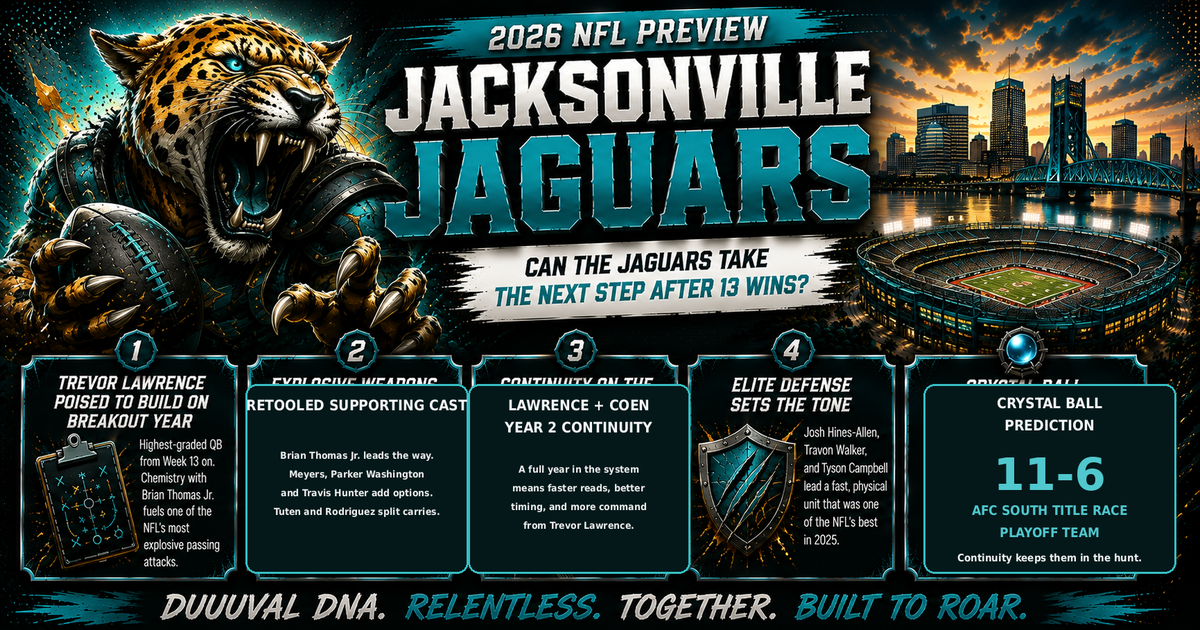
Trevor Lawrence was the NFL's highest-graded quarterback from Week 13 through the end of the postseason. He did not just play well -- he played with the kind of confident, decisive efficiency that makes an offense look inevitable. His chemistry with Brian Thomas Jr. developed into one of the more dangerous quarterback-receiver connections in the conference. He managed Coen's system with command, got the ball out quickly, and stopped making the kind of costly mistakes that defined his early seasons in Jacksonville.
The transformation was the direct result of two things working together: the offensive line stabilizing enough to give Lawrence time to process, and Lawrence himself growing into a quarterback who trusts his reads instead of waiting for the perfect throw. Coen's system rewards exactly that -- quick decisions, defined reads, and getting the football to playmakers in space rather than forcing the quarterback to create something from nothing.
Year 2 of that system gives Lawrence the benefit of accumulated knowledge. He enters 2026 having already operated Coen's offense for a full season, with a training camp of continuity behind him. The early camp reports from Jacksonville suggest Lawrence is operating at a different level than he was even at this time last year -- more decisive, more comfortable, more in command.
The question is whether the January tape was a ceiling or a floor. If it was a floor, the Jaguars are a Super Bowl contender. If the Bills simply exposed something structural, the regular-season run could end the same way it did in 2025.
Brian Thomas Jr. and a Retooled Supporting Cast
Brian Thomas Jr. is the highest-ceiling piece in Jacksonville's passing game, and he is entering his third NFL season after two years of showing how explosive this offense can be when he and Lawrence are in rhythm.
Thomas gives Lawrence a receiver who can win vertically, create after the catch, and be the target the offense comes back to when everything else is covered. He is 23 years old. The ceiling on this player is significant, and the combination of Thomas and a fully operational Lawrence gives Jacksonville an offense capable of scoring against anyone.
The supporting cast has been reorganized. Travis Etienne Jr. departed, and the Jaguars replaced him with a backfield led by Bhayshul Tuten and Chris Rodriguez Jr. Rodriguez gives Coen a physical runner who fits the downhill identity he prefers, while Tuten adds the speed and receiving ability Jacksonville still needs after losing Etienne's versatility.
Jakobi Meyers and Parker Washington round out the receiver room, giving Lawrence a reliable intermediate option and a slot threat behind Thomas. Travis Hunter, listed on the 53-man roster as a two-way receiver/cornerback, adds another wrinkle because Jacksonville can use him as a package player on offense while letting him settle into a larger defensive role. Brenton Strange remains the top tight end after emerging as one of the league's better young players at the position, while Nate Boerkircher, the tight end taken in the second round, gives Jacksonville another young receiving option in a room built for more multiple-tight-end looks.
The offense is functional and dangerous. It is also thinner than it could be. Coen did not add a proven alpha opposite Thomas, and the Tuten/Rodriguez backfield has to replace Etienne's all-purpose value by committee. If the defense forces Jacksonville to throw into unfavorable situations repeatedly, the supporting cast around Thomas becomes a real constraint.
The Defense That Makes This All Work
The best argument for the Jaguars being legitimate AFC contenders in 2026 is the same argument that was true last season: Josh Hines-Allen and Travon Walker give Jacksonville one of the most dangerous edge-rushing duos in football.
Hines-Allen is a Pro Bowl-caliber pass rusher who generates pressure on a consistent basis and makes offensive coordinators structure entire game plans around accounting for him. Walker has developed into a legitimate second edge threat who can win one-on-one reps on his own -- the Jaguars have moved him inside in nickel packages as an interior rusher, which creates an additional dimension that offensive lines cannot always adjust to in real time.
Behind them, the linebacker and secondary give Anthony Campanile's defense the pieces to play the complementary football that kept Jacksonville in games last season. The defense was one of the reasons the eight-game winning streak was possible -- games won by containing opposing offenses while Lawrence managed the ball efficiently and Thomas made the big plays.
The continuity on the defensive side matters. Campanile's second year means a defense that already knows the system, already has the communication worked out, and does not have to spend September getting comfortable. That is an advantage that shows up in October and November, when the division race gets serious.
Defending the Division Title
The AFC South is more competitive in 2026 than it was when Jacksonville won it. Houston went 12-5 last year and rebuilt its offensive line around Stroud. The Jaguars won the division at 13-4 but then lost a 27-24 game to Buffalo in the Wild Card round. The margin between first and second place in this division may come down to a game or two, and the Texans have the personnel to push.
What Jacksonville has that Houston does not is a healthy, functioning quarterback entering the season with a year of Coen's system under his belt and an eight-game winning streak's worth of confidence. Lawrence in the second half of 2025 was as good as he has ever been. If that Lawrence shows up in September, the Jaguars will be hard to beat in this division.
If the offense stalls -- if the post-Etienne backfield proves more costly than expected, or if opposing defenses find a way to take Thomas away -- the questions about the quiet offseason become louder. Winning 13 games and standing largely pat is a bet that you have the right pieces. That bet gets evaluated over 17 games.
Crystal Ball Prediction
Win total: 11-6. AFC South title race, playoff team.
Eleven wins is a slight step back from last year's 13, reflecting a tighter division race and a roster that did not add what it probably needed to add. The Jaguars are still a very good football team with a very good quarterback, a dangerous receiver, and an edge-rushing duo that can carry a defense. They will be in the playoff picture.
Whether they go further in January than they did last year depends on Lawrence continuing to play at the level he reached in the second half of 2025. Buffalo made the winning-time plays Jacksonville could not in that Wild Card game. The Jaguars chose to bet mostly on improvement from within rather than splashier additions from outside. Whether that was the right call is what the 2026 season will decide.
Trevor Lawrence is ready, and the late addition of Quinn Ewers as a developmental backup gives Jacksonville one more young quarterback in the room without changing the stakes around its starter. The roster around Lawrence is good enough. Whether it is great enough -- that is the question Jacksonville has to answer.
Make your NFL picks at Crystal Ball Picks.