The Indianapolis Colts started 8-2 last season. They were the surprise story of the AFC, a team that had found something with Daniel Jones at quarterback and Jonathan Taylor running behind him, a team that looked like it was finally breaking through the cycle of promising starts that never materialized into playoff runs.
Then they lost seven straight to close the season and finished 8-9.
That collapse does not erase what happened in the first ten weeks. It does not mean Jones cannot play or that the roster is broken. But it raises a harder question about whether this team has the depth and the late-season durability to be what it looked like in October. And now Jones is coming back from a torn Achilles that ended his season, Anthony Richardson is on the roster after requesting a trade that was never completed, and general manager Chris Ballard is heading into a year that many consider make-or-break for his tenure.
Indianapolis has genuine pieces. Taylor is one of the best running backs in football. Sauce Gardner is one of the best cornerbacks in the game. Jones, when healthy, was a top-10 quarterback through the first half of 2025. The ceiling on this team is real -- if everything holds together, the Colts can compete for a Wild Card spot.
The floor is also real. A torn Achilles recovery, a disgruntled former first-round quarterback, and a seven-game losing streak that wiped out the best start in years leaves a lot of questions that only the 2026 season can answer.
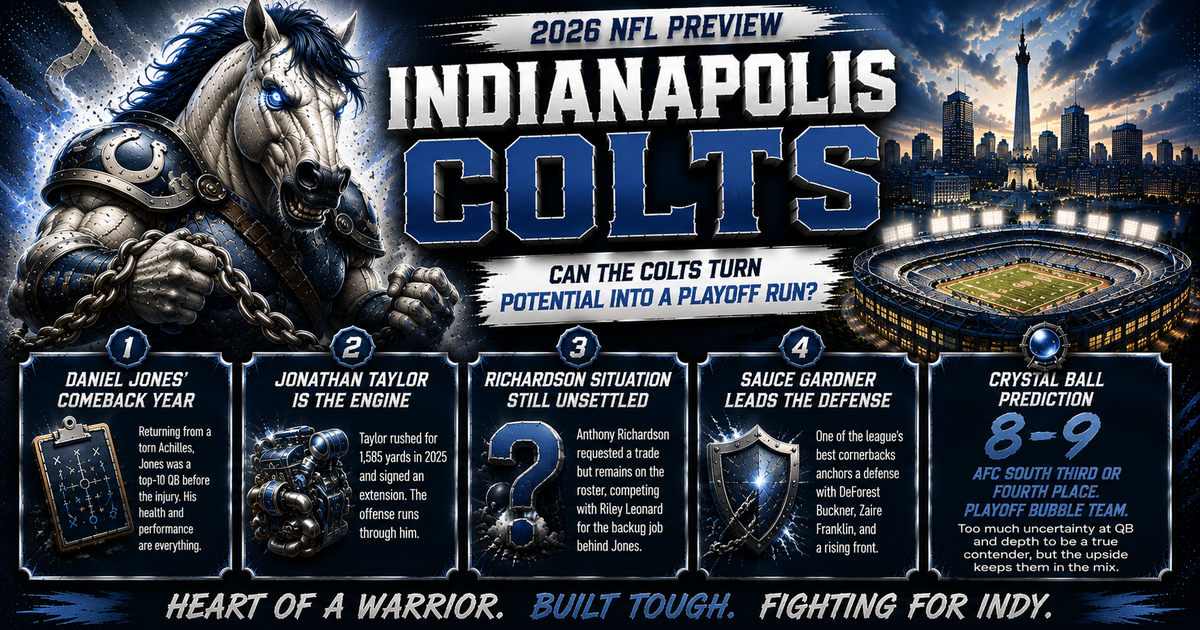
Daniel Jones and the Achilles Question
Everything about the Colts' 2026 season begins with whether Daniel Jones is the same quarterback he was before his torn Achilles.
Jones tore his Achilles in 2025 after one of the best stretches of his career. Before the injury, he led the NFL in passing yards through Week 10 and finished the season among qualified quarterbacks third in yards per attempt, fourth in completion percentage, sixth in passer rating, seventh in QBR, and seventh in passing yards per game. He was the biggest reason the Colts started 8-2. He was operating with efficiency and decisiveness that made the offense genuinely difficult to defend, and his connection with the skill position players around him looked like the kind of thing that takes multiple seasons to develop.
He has been cleared to participate fully in training camp after signing a two-year extension. He says he feels healthy. The camp reports have him as a full participant. The physical indicators are positive.
But Achilles recoveries for quarterbacks are complicated in ways that do not always show up in training camp. The explosion off the back foot, the confidence to move in the pocket, the trust in the plant-and-throw mechanics that make accurate deep passes possible -- those things come back at different rates for different athletes, and the first time a quarterback takes a hard shot on a healing Achilles, the mental side of the recovery becomes as important as the physical.
Jones at his 2025 peak is good enough to get the Colts to the playoffs. Jones at 70 percent of that peak, managing an injury recovery through October and November, is a much harder proposition. Which version shows up in September is the most important variable in the entire season.
Anthony Richardson Is Still Here. Somehow.
The most uncomfortable roster situation in Indianapolis is the one that has not been resolved.
Anthony Richardson, the fourth overall pick in the 2023 NFL Draft, requested a trade before the 2026 season. The trade has not happened. Richardson is still on the roster, still at practice, and still battling Riley Leonard for the backup job behind Jones.
Richardson's situation is one of the stranger ones in the league. He is a player with elite physical tools -- the arm, the size, the rushing ability -- who has not been able to stay healthy or develop consistency in the pocket. His trade request reflects a player who wants a fresh start and a chance to prove himself as a starter somewhere. Indianapolis retaining him reflects an organization that either cannot find the trade value it wants or is waiting for a better offer.
Whatever the reason, Richardson practicing as the backup to a quarterback returning from a torn Achilles is a situation that carries inherent tension. If Jones struggles and the organization turns to Richardson, every snap he takes becomes a showcase for teams considering a trade. If Jones goes down to injury, Richardson suddenly becomes the starter for a team he has been trying to leave.
Ballard has said his intention is to keep all three quarterbacks -- Jones, Richardson, and Riley Leonard -- on the roster. Whether that holds through the first meaningful injury or trade offer is a different question.
Jonathan Taylor Is Still the Engine
Whatever happens at quarterback, the Colts have a legitimate running back.
Jonathan Taylor rushed for 1,585 yards in 2025, reminding everyone who forgot during his injury-marred earlier seasons exactly how good he is. He signed a two-year, $44 million extension this offseason that commits him to Indianapolis, and the offense is built around his ability to create explosions on the ground and keep defenses honest enough to open the passing game.
Taylor is the player who made the 8-2 start possible. Jones was efficient, but Taylor was the identity. A defense that had to honor the run gave Jones the play-action opportunities he needed to pick apart coverages. When Taylor is running at full speed and getting 20 carries a game, the Colts' offense is built around something real.
The challenge is sustaining that identity through January. The late-season collapse was partly injury-related and partly a schedule that caught up with the team, but it also reflected a roster that did not have enough depth to stay competitive when things went wrong. If Taylor stays healthy and the offensive line holds up, the ground game gives the Colts a floor. If the line breaks down or Taylor hits a rough patch, there is not enough behind him to compensate.
The Pass Catchers Matter, Too
The Jones recovery and Taylor extension are the headline offensive stories, but the pass-catching group matters just as much if Indianapolis is going to hold up for 17 games. Alec Pierce re-signed after becoming one of Jones' most trusted downfield targets, Josh Downs gives the offense a reliable slot option, and rookie tight end Tyler Warren gives Steichen another middle-of-the-field answer.
The late addition of Keenan Allen adds a veteran route runner who can help Jones stay on schedule, especially if the Achilles recovery limits some of the off-platform creation early. This is not the deepest receiver room in the AFC, but it has enough defined roles to make the offense more than Taylor and play-action.
Sauce Gardner and the Defense
The most significant roster addition Indianapolis made was not this offseason -- it was the midseason trade for Sauce Gardner in 2025, which cost two first-round picks and Adonai Mitchell and gave the Colts one of the best cornerbacks in the game.
Gardner is a legitimate shutdown corner who changes what a defense can do. When he is covering a receiver, that side of the field becomes a near-no-go zone for opposing quarterbacks. The Colts' defense with Gardner on the field is a different unit than the one they had before he arrived.
Whether the two first-rounders were worth it is the question the franchise has to answer over several years. In the short term, Gardner gives the defense a centerpiece that most teams in the AFC do not have. If the Colts can build a legitimate contender around him while he is here, the cost becomes justifiable. If the team misses the playoffs again in 2026, those two picks are going to sting.
Laiatu Latu gives the defense its highest-upside edge rusher, while Arden Key adds veteran pressure and DeForest Buckner and Grover Stewart keep the interior sturdy. The defense is not elite, but with Gardner and Charvarius Ward Sr. anchoring the outside corner spots, it is good enough to win games -- particularly if the offense can stay ahead of schedule and avoid third-and-long situations that expose the depth behind the starters.
The Ballard Make-or-Break Framing
The 2026 season carries weight for the franchise beyond wins and losses.
General manager Chris Ballard has been in Indianapolis since 2017. He has built a team that has hovered around .500 and won only one playoff game in that span. The 8-2 start last year looked like the breakthrough. The 8-9 finish looked like the same pattern on a longer timeline. The Gardner trade was the kind of aggressive, committed move that win-now organizations make. The Achilles recovery, Richardson's trade request, and the late-season collapse put all of that commitment under pressure.
If Jones returns healthy, Taylor runs at his 2025 level, Gardner locks down the back end, and the Colts compete for a Wild Card spot, Ballard looks like a general manager who finally put it together. If the collapse continues, if the quarterback situation remains unresolved, and if Gardner's draft picks turn into another team's foundation, the evaluation changes.
The Colts are not a bad team. They are a team at a crossroads, and the 2026 season is where the direction becomes clear.
Crystal Ball Prediction
Win total: 8-9. AFC South third or fourth place. Playoff bubble.
Eight and nine is the honest number for a team with this many unanswered questions. Jones healthy and functional gives the offense enough to win the games it should win. Taylor gives the ground game a legitimate identity. Gardner gives the defense a centerpiece.
But the Achilles recovery is a real risk, Richardson's situation adds organizational noise, and the AFC South is harder than it looks with Houston pushing for the division and Jacksonville defending. The Colts will be competitive. They will win some games they should not and lose some they probably should have won. That has been the pattern.
Whether 2026 breaks that pattern depends on health, resolution of the quarterback situation, and whether Jones can be the player he was in October for an entire season rather than half of one.
Make your NFL picks at Crystal Ball Picks.